Showing posts with label research blogging. Show all posts

29 September 2012

The carnivorous plant with catapult traps


Drosera glanduligera (pimpernel sundew) shown here in a figure from the
new paper describing the fast-acting catapult traps (Poppinga et al., 2012).
Creative Commons Attribution License.
As usual, I'm late to the party and many other outlets have already written about this fascinating new paper published in PLoS ONE; such is the nature of the captivating world of carnivorous plant research. I'll try to place the new article in a bit more context.

First, the study organism: Drosera glanduligera, the pimpernel sundew, an Australian native, was first described in 1844 by Johann Georg Christian Lehmann who was cataloging and describing new species found in the collections of the botanical garden that he established and directed in Hamburg (now called Alter Botanischer Garten Hamburg). My botanical Latin needs a good refresher, but at a quick glance it appears to me that Lehmann noticed enough to write down that the marginal tentacles of this species are larger, but that's the only observation he recorded. Indeed, as you can see in the photo above, the marginal tentacles are much longer than the glue-tentacles closer to the center of the leaf lamina (more on this later).

Drosera regia, king sundew.
My plant in cultivation.
It turns out that, at least with this species, nothing more was recorded on what is apparently a fascinating trapping mechanism more analogous to the fast snap trap action of the Venus flytrap swiftly snatching a meal as seen here. That is until Richard Davion began making new field observations in 1974 when he wasn't even ten years old yet and published them in the 1990s in the relatively low circulation newsletter of the Carnivorous Plant Society of New South Wales. This underscores the importance of publishing new observations in journals where your work might get noticed. Davion later contacted two authors of the current study, the Hartmeyers, in 2003 and asked them to corroborate his findings. Within two years they confirmed Davion's observations and presented a film titled, "Drosera: Snap-Tentacles and Runway Lights," at the International Carnivorous Plant Society conference in 2006 that summarized their findings. (The video can be seen in full on YouTube courtesy of the ICPS.)

Snap tentacles: Everyone is excited about this research - and rightly so - but what exactly are snap tentacles and how do they differ from regular tentacles on sundews? On most sundew species like this Drosera regia above and to the right, there is one kind of tentacle: a few-celled stalk supporting a multicellular, glandular, globular head. They vary in length from the center to the edge of the leaf but not in overall morphology. They produce and rely on a viscous mucilage to retain captured prey until the tentacles slowly move (in some species, if at all) and direct the prey toward the digestive glands at the center of the lamina. This can take minutes, even half an hour depending on temperature. The snap tentacles, on the other hand, produce no mucilage and typically have a faster movement. The multicellular head is modified and looks more like a spatula or a pillow resting on oversized spoon (or maybe like a catapult?). They quickly flip unsuspecting prey up and into the center of the remarkably sticky mucilage produced by other tentacles. In milliseconds the prey can reach a maximum velocity of 0.17 m/s and a maximum acceleration of 7.98 m/s. Before it can think or react, it's deposited in the lamina where it's immobilized and often suffocated by the mucilage. Any struggling is futile as other slower tentacles reposition the prey nearer the digestive glands. A few days later after the plant's enzymes have done their work, meal time is complete and new leaves are unfurling, awaiting new dinner guests.

About two years ago, two of the authors of the current study, Siggi and Irmgard Hartmeyer, published their findings on over 100 Drosera taxa in the Carnivorous Plant Newsletter while investigating snap tentacle morphology. They concluded that many species of Drosera from multiple points on the established phylogeny of the genus have snap tentacles of some kind at some point in their ontogeny that vary in how swift the response is. It's important to note, however, that in the 2010 paper they set aside the tentacles of Drosera glanduligera as something wholly different since it was the fastest and the mechanism wasn't quite clear. This may be the reason why we can refer broadly to snap tentacles and flypaper traps on all the species but this one alone has been granted the new term catapult-flypaper-trap.

For their part of the new study, Irmgard and Siggi cultivated the plants, captured new HD film, and created this documentary to accompany the paper's release. Now this is effective science communication (in German with captions in English). If you want to skip the beginning and see the plant in action, make your way to about the 5:00 mark.


So that's cool! A catapult that helps deliver prey in the center of the trap. What else did they find? I'm glad you asked. These tentacles move by some pretty awesome mechanisms since they're moving so quickly - did you watch the video? It completes that swing from laying on the ground to delivering the prey to the hungry center of the leaf in as little as 75 milliseconds. In their investigation, the research team found that these snap tentacles actually deform beyond the ability to "reset" in a resting position to fire once again like the Venus flytrap can. They hypothesize that the cells in the hinge zone actually buckle from the stress involved with the movement - nature's one use only device.

In the discussion, they spend a good bit of real estate on hypothesizing on the mechanism involved: is it rapid water movement from one side of the tentacle to the other or loss of turgor pressure in combination with what would essentially be the release of stored potential energy by a sudden geometric change or curvature inversion not unlike this child's toy (oh, you know you remember annoying your parents with one of those.) But they didn't find any noticeable inversion. This may not be all that different from other tentacle movement (and the initiation of movement in the Venus flytrap) where the acid growth hypothesis is supported. Simply, in acid growth a signal would cause H+ ions to be pumped out of the cell into the cell wall space where proteins in the cell wall matrix known as expansins loosen at an acidic pH (higher H+ concentration). That allows the cells to increase in size very rapidly. If you do this on only one side of the tentacle, the lower surface, the result would be rapid bending inward. There are ways to inhibit the transporters associated with acid growth, but it might take the skills of a fine surgeon to delicately and strategically place the inhibitors on the tentacles without prematurely triggering them!

Regardless, there are plenty of possibilities here for future research, much of which was identified by the authors themselves in the last few paragraphs. Congratulations all around for such an attention-grabbing paper that was even blamed, in part, for slowing down the PLOS website:


References:
Poppinga, Simon, Siegfried R. H. Hartmeyer, Robin Seidel, Tom Masselter, Irmgard Hartmeyer, & Thomas Speck (2012). Catapulting Tentacles in a Sticky Carnivorous Plant. PLoS ONE, 7 (9): e45735. 10.1371/journal.pone.0045735

Hartmeyer, Irmgard, & Siegfried R. H. Hartmeyer (2010). Snap-tentacles and runway lights: summary of comparative examination of Drosera tentacles. Carnivorous Plant Newsletter, 39 (4), 101-113.

12 June 2012

New study on carnivorous plants makes headline writers batty

sciseekclaimtoken-500248d42bb9e


Before we get started, let me say that I forgive those who write headlines like pollution makes carnivorous plants go vegetarian and carnivorous plants go vegetarian in response to pollution and new study finds that pollution turns carnivorous plants into vegetarians. They know not what they do. It's also tempting to go after the flashy, attention-grabbing headline. Just try to do a better job next time, ok? And while we're on the topic, let us thank those that presented reasonable titles, like the one by Liat Clark at Wired.co.uk: carnivorous plants capture less prey in polluted bogs. Thank you for getting it a bit better! It would also be a terrible oversight if I neglected to mention that the Southern Fried Scientist took this issue to task a few days ago. Bravo!

So, on to the science at hand. What's all the fuss about?

Triangle Lake Bog, Ohio
Drosera rotundifolia at Triangle Lake Bog, Ohio. Photo by kitkor.
ResearchBlogging.orgDrosera rotundifolia, the round-leaved sundew. Or common sundew. Or "bloody hell that thing is everywhere." And it is: North America, Europe, Asia... Here in Ohio it is the most common species of Drosera that you'll bump into - the other being Drosera intermedia, but several sites it had been known from have now been developed. For those unfamiliar with carnivorous plants, you might be peripherally aware that it is thought that these species have evolved in nutrient-poor environments. Given this idea and our knowledge that most species possess a good deal of phenotypic plasticity in response to environmental cues, researchers decided to further test earlier experimental observations that Drosera rotundifolia reduced its investment in carnivory (as measured by stickiness in units of force used to remove a piece of filter paper from the leaf) when grown in the presence of more nitrogen (Thorén et al., 2003).

Here in the new study, the researchers, a team including J. Millett of Loughborough University, B. M. Svensson and H. Rydin of Uppsala University, and J. Newton of the Scottish University Environmental Research Centre, were more interested in the relative amount of nitrogen that came from prey captured by normal means and from the roots as a result of increased nitrogen available from atmospheric deposition due to increased air pollution.

Briefly, the authors identified three bogs in Sweden that represented a gradient of mostly pristine to somewhat polluted in terms of nitrogen deposition. Fifteen specimens were removed from the bogs, dried, and analyzed for stable isotopes of nitrogen. Once they had their isotope data, all they did was subtract surrounding Sphagnum isotope data from Drosera and divide that by (insect - Sphagnum), where insect represents the mean isotope number for prey captured on the plant at the time of collection. And there's an easy ratio!

So conclusions from this? Well, the authors state it very clearly in the abstract, which many of the headline writers must have missed: "Drosera rotundifolia plants in this study switched from reliance on prey N to reliance on root-derived N as a result of increasing N availability from atmospheric N deposition." (emphasis mine) No, headline writers, these plants were not "OMG BECOMING VEGETARIANS!" Wouldn't that be a plant eating plant matter? And, as strange and wonderful as nature is, we have two possible examples in Nepenthes ampullaria and Utricularia purpurea where the former seems well-adapted to catch leaf litter and the latter appears to primarily cultivate algae in its bladder-like aquatic traps. No, dear headline writers, increased pollution will not turn Drosera rotundifolia into a vegetarian. It may, however, given this work and that before it, be the cause of changing priorities in nitrogen uptake from primarily prey-derived to primarily root-derived. It should be noted, however, that the authors did not set out to assess prey capture rates in these areas, so any statement has to be carefully worded and specifically related to nitrogen assimilation from different sources. We don't know if the plants in areas with more nitrogen capture fewer arthropods. It's entirely possible that the plants that incorporate more nitrogen from their roots capture the same number of prey but preferentially assimilate the nitrogen from the roots.

More troubling, however, is that with increased nitrogen availability in these once off-limits landscapes, opportunistic species may find it easier to overcrowd the poor little perennial carnivorous herbs. (Of course, the increase in nitrogen in this study was not very large and probably would not be enough to allow non-bog-adapted species to thrive.) Most carnivorous plants are low to the ground and depend on high light conditions to thrive; if shaded too much, they may soon succumb to succession. Of course this is only a hypothesis and needs to be studied! I wonder what the headline writers will say then...


References

Millett, J., Svensson, B., Newton, J., & Rydin, H. (2012). Reliance on prey-derived nitrogen by the carnivorous plant Drosera rotundifolia decreases with increasing nitrogen deposition New Phytologist, 195 (1), 182-188 DOI: 10.1111/j.1469-8137.2012.04139.x

Thoren, L., Tuomi, J., Kamarainen, T., & Laine, K. (2003). Resource availability affects investment in carnivory in Drosera rotundifolia New Phytologist, 159 (2), 507-511 DOI: 10.1046/j.1469-8137.2003.00816.x

24 February 2012

The orchid that smells like Chanel No 5


Hyacinth orchid
Dipodium roseum, a parasitic Australian relative. Photo by Ian Sutton.

ResearchBlogging.org The orchid genus Dipodium, collectively known as the hyacinth orchids, includes somewhere between 20 to 30 species native to Southeast Asia and Australia. Interestingly, the majority of the species are leafy epiphytes - well, terrestrials that climb and then become epiphytes - dispersed throughout Southeast Asia. A small group of these plants, however, have lost the leaves entirely and live as terrestrial parasites at the base of Eucalyptus trees in Australia.

This, of course, is interesting on its own, but what caught my attention today was the description of a new species in 2006 by Peter O'Byrne and Jaap Vermeulen. They found Dipodium fragrans growing in eastern Johor state of Peninsular Malaysia, inhabiting the lowland swamp-forests common to the area. Dipodium fragrans, as you can deduce from the species epithet, is heavily perfumed, so much so that it led to this humorous description, hidden away among the often stuffy and sometimes inaccessible language of academic botany:
D. fragrans is noteworthy in two other respects: the inflorescence is often branched, and the flowers are strongly fragrant, hence the specific name. Vermeulen describes the scent as "being like Chanel No 5", while O'Byrne (a poor schoolteacher) is ignorant about luxury fragrances and likens the scent to frangipani's.
Science, including the scientific descriptions of  new species, could learn a lesson from O'Byrne and Vermeulen. A little humor, properly placed, makes for a more engaging read. It certainly stuck with me more than if that comment had been omitted!


Reference:

O'Byrne, Peter, and Jaap Vermeulen (2006). Two Cheirostylis species and a new Dipodium. Malayan Orchid Review, 40, 91-94

09 January 2012

Philcoxia: The plant that ate the nematode on subterranean leaves


ResearchBlogging.orgCould it be? Do we have confirmation of a new genus of carnivorous plants? Possibly. The small genus Philcoxia, which is endemic to Brazil and consists of only three diminutive species, was only just described in 2000. Even in the original description of the plants, authors were noting stalked glands and sticky leaves with later studies observing dead nematodes covering the leaves. These were just hints at the possibility that the plants were deriving some benefit from trapping and killing the wee-beasties and thus might be true carnivorous plants. Definitions vary, but for a plant to be considered carnivorous, it must be demonstrated that the plant has adaptations to (sometimes) lure, trap, and digest prey, absorb the nutrients, and crucially, derive some benefit from it.

Philcoxia minensis - source: Pereira et al., 2012.
But let's back up here. What did we know before this study? Philcoxia grows in nutrient-poor sandy soils, oddly holding its leaves at or just below the ground surface so that the leaves are often covered with sand grains. They have poor root systems, aren't very tall even when in flower, and usually have 5-10 leaves on each plant. When the leaves were examined closely, they were covered in dead nematodes, captured by the sticky secretions among the stalked glands on the upper surface of the leaf.

Sounding familiar yet? To anyone that's acquainted with the other flypaper-type carnivorous plant traps like the sundews (Drosera) and butterworts (Pinguicula), the above description checks all of the boxes for what you'd look for in a carnivorous plant: the need to derive nutrients from sources other than soil, sticky leaves with stalked glands, often ephemeral habits. Most important until this point was the direct observation of nematode prey, published in a 2007 article. The poor nematodes didn't know what hit them; they were mindlessly searching for a brunch of bacteria and they ended up on the menu instead. The 2007 study tested for a common digestive enzyme, proteases, that are often a hallmark of carnivorous plants but detected none, noting, of course, that absence of proteases did not preclude the possibility that Philcoxia was carnivorous after all.

Typical habitat of P. minensis at Serra do Cabral, Minas Gerais, Brazil.
Source: Fritsch et al., 2007

The present study by Pereira et al. (2012), published online ahead of print in PNAS, finally digs deeper and provides us with more experimental evidence. The authors went out into the field, collected plants of P. minensis, and acclimated them to the greenhouse. In what has become standard procedure for determining movement of nutrients from prey to plant, the authors fed 15N-labeled C. elegans nematodes to the plant and left it for 48 hours. The presence of the isotope in the plants cleared of all nematodes after that period of digestion easily indicates that the source of the 15N was the nematode. Compared to controls where no nematodes or nematodes reared without the isotope were fed to the plant, a significant 15% of the isotope originally found in the prey was now found in the leaf biomass after 48 hours. The increase in 15N was associated with an overall increase in nitrogen content of the leaf. My only criticism here is that sample size for all treatments was relatively low at n = 8 and thus the standard error bars are large, though I fully recognize that this is a difficult species to cultivate. I'm also likely spoiled by my time in a microbiology lab where sample size was almost never a problem. As preliminary evidence, this is quite promising! (Out of curiosity, I would have loved to see data on 15N from parts of the plant other than the leaves, since transport of nutrients would be efficient in that 48 hour period.)

While absorption of labeled nutrients from nematode prey is an indication of foliar uptake of nutrients, Pereira et al. conclude that this is also evidence for digestion via the plant's own digestive enzymes. (As an aside, I note that foliar absorption of mineral nutrients is common in plants.) This is a bigger leap from evidence to conclusion and isn't well supported. What we know from Pereira et al. is that the leaves do produce lots of phosphatases, another one of the digestive enzymes that indicates carnivorous activity. It's an easy inferential leap to make from presence of phosphatases and assumed absence of bacterial activity on the leaf's surface in the greenhouse experiment that could otherwise explain the mineralization instead of direct action of the plant. It would be difficult, but ideally Philcoxia should be grown in tissue culture in the absence of bacteria, then be fed the isotope-labeled nematodes for the most convincing data to support the idea of digestion via the plant's enzymes alone.

A group of P. minensis leaves in the sand.
Source: Pereira et al., 2012
The authors also measured neighboring noncarnivorous plants in the field and noted that Philcoxia has a significantly higher nitrogen and phosphorous content. This begins to address the "benefit" part of the definition of carnivory. The higher nutrient content may be an indication of a benefit from the nematodes and the authors note that further investigation, including direct observation of photosynthetic rates, is already underway. More convincing might be an clear increase in biomass or seed set, but with such small plants, elevated photosynthetic rates might be a better measure.

In summary, Philcoxia traps and kills nematodes on subterranean leaves, possibly digests it with enzymes such as phosphatases produced by the plant, absorbs the nutrients, and possibly derives a benefit from the prey in that the plants have higher nutrient content than their noncarnivorous neighbors in the unforgiving and nutrient-poor environment. What's conspicuously missing here is evidence of a lure or attractant. What's the normal concentration of nematodes in the sand surrounding the plant? Is their capture accidental or are they drawn to their death on the subterranean leaves? These questions were also identified by the authors as avenues for further research. I look forward to these!

In my assessment, with further data we can certainly add this genus to the ranks of true carnivorous plants. As Pereira et al. mentioned, this has implications for our understanding of the number of times carnivory has evolved among plants since Philcoxia belongs to the plantain family (Plantaginaceae), which previously counted no known carnivorous plants among its members. Depending on which you include, this means that plant carnivory has evolved at least 7 times independently, a fact I find amazing to ponder.

(h/t to Paul Riddell of the Texas Triffid Ranch for originally pointing me to this new research. Thanks!)


References:

Pereira, CG, Almenara, DP, Winter, CE, Fritsch, PW, Lambers, H, & Oliveira, RS (2012). Underground leaves of Philcoxia trap and digest nematodes. Proc. Natl. Acad. Sci. USA : 10.1073/pnas.1114199109

Fritsch, PW, Almeda, F, Martins, AB, Cruz, BC, & Estes, D (2007). Rediscovery and Phylogenetic Placement of Philcoxia minensis (Plantaginaceae), with a Test of Carnivory Proc. CA Acad. Sci., 58, 447-467

Taylor, P., Souza, V., Giulietti, A., & Harley, R. (2000). Philcoxia: A New Genus of Scrophulariaceae with Three New Species from Eastern Brazil Kew Bulletin, 55 (1), 155-163 DOI: 10.2307/4117770

08 January 2012

The peculiar modification of the locket triggerplants


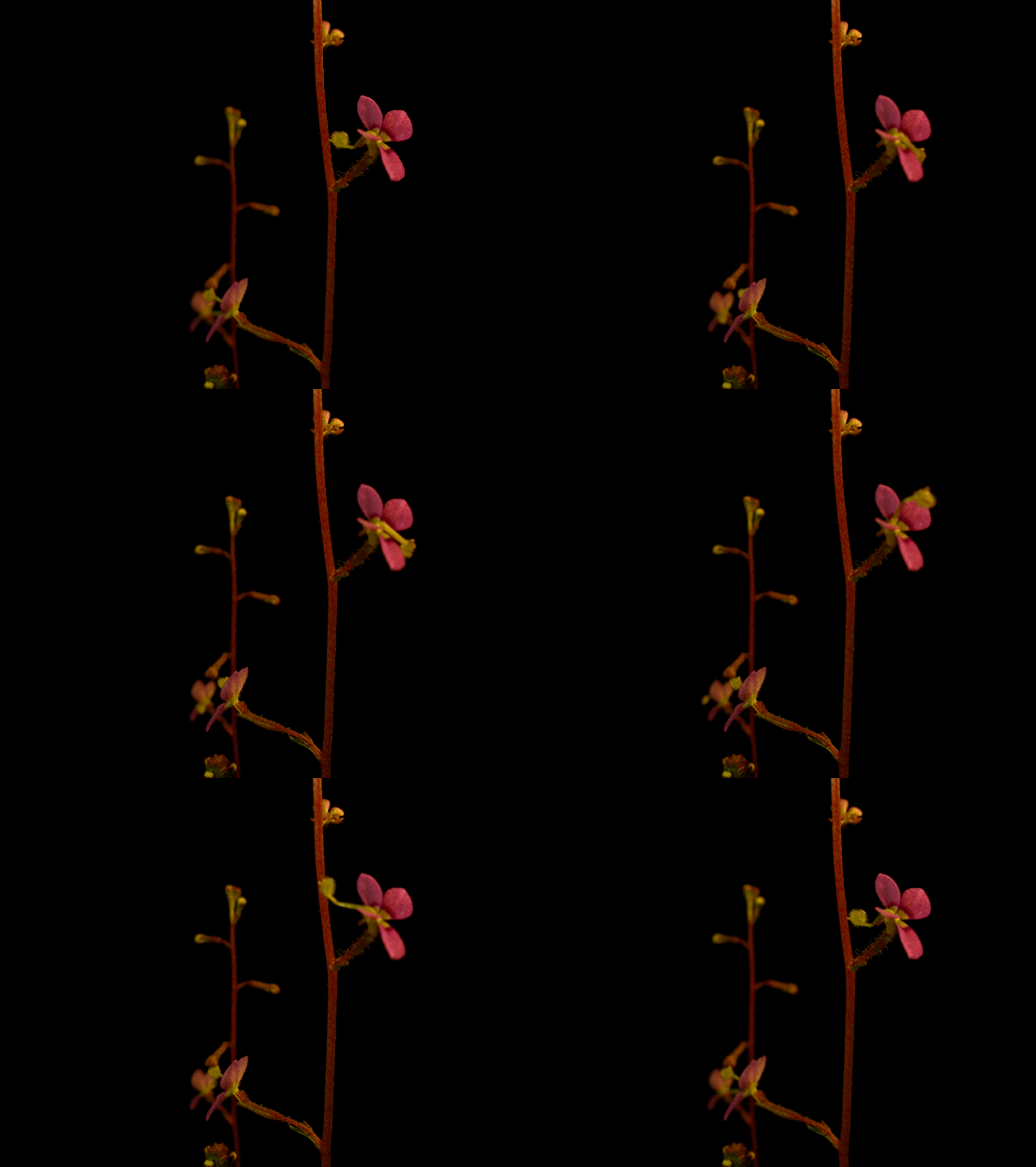
ResearchBlogging.orgCunabulum. If you know your Latin, you might recognize this as "cradle" or "nest." If you do a Google search for it, you'll get a lot of hits for this blog, a few dictionary entries, and a helpful note that wants to know if you meant to search for incunabulum instead. (FYI, incunabulum, according to Wikipedia, refers to a "book, pamphlet, or broadside that was printed - not handwritten - before the year 1501 in Europe." And now you know.) Your search will also probably reveal the orchid species Phloeophila cunabulum, so named because its flower in some ways resembles a cradle. Conspicuously missing from the search results, however, would be the application of this Latin word to an interesting morphological feature of certain species of Stylidium, or triggerplants, a genus of small herbs mostly native to Australia.

Stylidium
Stylidium roseo-alatum - By Jean Hort. (Seriously, go follow her impressive photos on Flickr.)

There are plenty of reasons to be interested in Stylidium. For starters, the genus probably has around 300 species, which makes it the fifth largest genus in Australia. Their variety in color and habit (ephemeral, climber, creeper) is astounding. Did I mention that they may be carnivorous? Most notable of all, perhaps, is the irritable column or "trigger" - the fused male and female reproductive organs that hang beneath the flower and snaps into action, dusting pollinators with pollen when they come for a sip of nectar.

Stylidium debile - An animation of the column resetting after firing; each frame is 1 min.

The complex column, a feature that many plant groups possess combined with the fact that it is one of the faster plant movements in completing its swing in 15 milliseconds is amazing enough. But if you really study this variable genus, you will find diagnostic differences in the morphology of that remarkable column. There's one particular group singled out for its interesting characteristics. I'll let Rica Erickson, the distinguished Western Australian naturalist who passed away just a few years ago at the age of 101, describe this for us:
There is a peculiar in-folding at the apex of the Locket Triggerplant's column. It bends forward into a pouch formed by the dilatation of the column itself. It thus resembles a miniature locket with elastic hinges, enclosing the precious packet of pollen inside the lid. This can be prised apart with a pin to reveal the four neat divisions of the anthers within. ... As the stigma develops it becomes more bulky and no doubt heavy enough to cause the hinge to lose some of its elasticity and at this stage the locket hangs partly open. (Triggerplants, 1958. p. 70.) [Emphasis added]
So, the anthers develop first, then thwack, the trigger deposits pollen on the back of visiting grey-flies. After the pollen is shed, the sticky stigma develops and pushes the anthers out of the way. The plant is now ready to receive pollen from other plants in the same manner that it just parted with its own pollen, a clever evolutionary adaptation to promote cross-fertilization.

Stylidium turbinatum - Column in the set position to the left and beneath the
petals, with prominent stigma and anthers pushed to the side. The "locket" here
is somewhat open, possibly because the stigma is heavier or because of multiple firings.
Source: Holger Hennern.

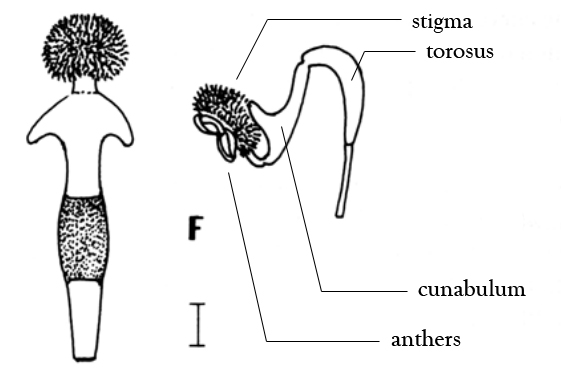
(I should mention here that a modern interpretation of species that possess a cunabulum by Australian botanist Juliet Wege excludes S. turbinatum, noting that the column is only slightly broadened and a complete cradle for the anthers is not formed; Wege, 2006.) With the above photo of Stylidium turbinatum in mind, let's take a closer look at just the column of a different species, as drawn by another Australian botanist, Allen Lowrie:

Stylidium perizostera column - (Left) Looking down from
above and (right) view from the side. Scale bar = 1 mm.
Original drawing from Lowrie & Kenneally (1997), annotated by me.

At last! The cunabulum is clearly illustrated. This particular species, Stylidium perizostera, has lateral wings on the cunabulum. Most other cunnabula on other locket triggerplant species consist of a simple pouch. Both of the unfamiliar terms in the drawing above, cunnabulum (Latin: cradle) and torosus (Latin: muscular; in Stylidium, the sensitive mobile hinge) were chosen by Kenneally and Lowrie (1994) to be applied to the locket and hinge, respectively. Since then both words have been used only occasionally in this context, so they still remain obscure botanical terms, but they're useful when trying to use these features as diagnostic differences between species. To emphasize the special adaptation of the cunabulum, compare the backside of the widened portion of the column that corresponds to the cunnabulum in Stylidium turbinatum and the slender, smooth column found in other species like Stylidium purpureum.

So... what does it do?

Lizard Trigger plant
Stylidium preissii - the lizard
triggerplant, also with a cunabulum.
Photo by Jean Hort.
You may be asking yourself, it's a cradle that holds the anthers, so what? Is there any particular function that we can infer from the morphology? Rica Erickson, again:
What is the function of this peculiar modification of the Locket Triggerplant's column? Let us watch. We must stoop very low because the plant grows close to the ground, moreover the trigger is very small. Fortunately the flies are not too wary and we can see them probing. Notice how the column suddenly shoots over. See how the force of the flying trigger flings open the locket. The anthers are held erect and pressed against the fly's shoulder. The insect flies away and swiftly the elastic hinge refolds the anthers again. The trigger has to jerk quickly to swing open the locket.

What then can be the function of the pouch? Does it conserve the moisture of the pollen grains during the dry October heat? Or is it an economical device for saving the loose grains that spill out of the anthers while waiting for insect visitors? That may be the answer, for some pouches retain a little cluster of loose grains near the hinge. (Triggerplants, 1958. p. 70.) [Emphasis added]
After Erickson's initial hypotheses of preventing desiccation or loss prevention of precious pollen, the American botanist Sherwin Carlquist had his own impressions of the locket. One of my personal botanical heros, Carlquist began studying Stylidium species on his trip to Western Australia in 1962 with the aid of Erickson's book which he had found in a Perth bookstore. He returned to Australia several times and identified many new species in his meticulous studies of the Australian flora. In 1969, Carlquist addressed the widened columns or "lockets" mentioned by Erickson. In his assessment, the adaptation "appears to be nothing more or less than a method of achieving self-pollination" (Carlquist, 1969). While Erickson didn't explicitly mention self-pollination, the meaning can be inferred from her suggestion that the cunabulum saves the loose pollen grains, presumably for the stigma to receive.

But as Juliet Wege, the botanist currently working on Stylidium, mentions, many species in this genus have lethal post-zygotic barriers to self-fertilization. That is to say that if pollen from genetically identical individuals is received on the stigma, fertilization occurs but the embryo is aborted and viable seed is not produced. By all accounts, the floral column and trigger mechanism evolved to promote cross-pollination, further supported by the post-zygotic seed abortion found in perennial triggerplants of southern Australia. Wege concludes that, "[i]t is therefore unlikely that the locket has evolved as a self-pollination mechanism in the perennial creeping species..." (Wege, 2006). Wege goes on to explain that tropical annual species, on the other hand, that also have a widened column may have evolved the pouch-like dilation fringed by hairs (papillae) to retain pollen and promote self-fertilization. Annuals, after all, depend on high seed set to survive from year to year.

Stylidium eriopodum
Stylidium eriopodum - Here just to break up the wall of text. Photo by Jean Hort.


So if the function isn't pollen retention for self-fertilization among the perennial triggerplants from southern Australia, what about the other hypotheses? Erickson's idea that it prevents desiccation of pollen during the hottest and driest months of the season has not received much mention or any data to support or refute it. Wege (2006) throws one more hypothesis into the mix by noting her field observations that pollinators, specifically long-tongued flies, will hover near recently triggered flowers to steal pollen from the anther before it has the chance to reset. Could the cunabulum provide protection from pollen pilferers? It's an attractive idea, but no published data exists.

While we're left wondering what the exact function of a dilated column, pouch, locket, or true cunabulum is, we can also ponder the evolutionary history of the trait. We have widened columns of different varieties from simple to elaborate present in multiple lineages of Stylidium: tropical annuals, creeping perennials, tile-leaf triggerplants like S. preissii, scale-leaf triggerplants, and whorled-leaf triggerplants. Wege is currently working on the phylogeny of the genus, but it's quite clear that this "peculiar modification" has arisen a number of times in the evolutionary history of the genus. I look forward to resolutions of such interesting questions as these.

It is amazing to me how much can be written about, and inferred from, the structure of an morphological adaptation no greater than 3 mm long on the reproductive floral column found on a genus of Australian plants. This is why botany is endlessly fascinating. This is why I love botany.


References:
Carlquist, Sherwin (1969). Studies in Stylidiaceae: new taxa, field observations, evolutionary tendencies. Aliso, 7, 13-64.

Erickson, Rica (1958). Triggerplants. Paterson Brokensha Pty. Ltd., Perth.

Kenneally, KF, & Lowrie, A (1994). Stylidium costulatum (Stylidiaceae), a new tropical species of triggerplant from the Kimberley, Western Australia and the lectotypification of S. floodii. Nuytsia, 9 (3), 343-349.

Lowrie, A, & Kenneally, KF (1997). Eight new species of triggerplant (Stylidium: Stylidiaceae) from northern Australia. Nuytsia, 11 (2), 199-217.

Wege, J (2006). Taxonomic notes on the locket trigger plants from Stylidium subgenus Tolypangium section Repentes. Nuytsia, 16 (1), 207-220.


Thanks to Paul of the Texas Triffid Ranch for the recent mention. It provided motivation to finally get around to this overdue post. Cheers!

21 July 2011

Botanists vote to allow online publication of new taxa

The excitement (and nervous uncertainty) is tangible on botanical taxonomy e-mail lists with the recent news that the nomenclature section of the International Botanical Congress, the governing body of the rules on how we describe new species and other taxa, voted at this year's Melbourne conference to drop the requirement that all new taxa must be described in print publications. If the rule is adopted by the whole Congress, we'll soon see new taxa being published in online-only peer-reviewed journals like PLoS ONE.

Much of the discussion on online-publishing has surrounded the necessity for proper archiving and a sense of permanence on an otherwise ephemeral online realm where the paradox that full permanence may not be achievable yet it's hard to completely erase some online substance reigns. Last year Sandra Knapp of London's Natural History Museum took this outdated policy to task and defiantly published four new species of Solanum in PLoS ONE. She was able to skirt the printed publication requirement by following the other International Code of Botanical Nomenclature rules that allowed her to print out at least 10 copies and distribute them to libraries and a central name index. If the full IBC follows suit and votes for this new rule allowing online publication of new species, no one will have to follow Knapp's example.

This issue had come up at the last Congress in Vienna six years ago, but online journals were just getting off the ground and archiving systems were either poorly managed or lacking entirely. Heck, I was still using Livejournal. A lot has changed in the past six years. The measure didn't pass in Vienna, which I think was the right decision. We waited long enough that the technology caught up to meet the rigorous demands of proper taxon description.
Levenhookia murfetii from Mount Lesueur, Western Australia
Lowrie A, and Conran JG. 2011. Triggerplant Journal 1 (2): 4-29.

ResearchBlogging.orgIn a related matter, I recently noticed that noted Australian botanist Allen Lowrie, famous for his carnivorous plant descriptions, has described a new species of stylewort (Levenhookia) in the online-only Triggerplant Journal (Volume 1, Number 2), founded by Douglas Darnowski and Greg Bourke. It's beautifully illustrated with lovely photos, but as far as I can tell, and even though the journal has an ISSN, the description by Lowrie and his colleague John G. Conran of the new species Levenhookia murfetii (named in honor of Denzel E. Murfet) is not "effective" yet. And so until the new rules from the IBC go into force, all publications of new taxa should still be in print, or at the very least Lowrie and Conran need to print out ten copies of their article from the journal and submit it to libraries and one index, just as Sandra Knapp did with her Solanum species. It may be early to judge based on this, but so far the name Levenhookia murfetii has not been entered into the International Plant Names Index.

Update (27 July 2011): I recently heard from Greg Bourke, one of the publishers of the Triggerplant Journal, that the description of the new species Levenhookia murfetii was indeed printed out and distributed to validate the description. This is good news for this particular description. Perhaps IPNI is just behind on updating the database.

Now the zoologists can sit back and be jealous of the botanists, since the ICBN's zoological counterpart, the International Code of Zoological Nomenclature, has been considering such an amendment to their rules since 2008 but it has not yet taken any action. I'm okay with this.


Lowrie, A., & Conran, J.G. (2011). An overview of the Australian Levenhookia (Stylidiaceae) complex, including a new species (L. murfetii) and observations on the triggering methods employed for pollination and outcrossing. Triggerplant Journal, 1 (2), 4-29

09 May 2011

Is the common teasel carnivorous?

Dipsacus fullonum, the common teasel. An "urn" type
water storage, where dead arthropods collect.
Source: Björn Appel at Wikimedia Commons.
ResearchBlogging.orgDipsacus fullonum, the common teasel or Fuller's teasel, is an asterid native to Europe, Asia, and northern Africa, but is also introduced (and sometimes naturalized) in many other parts of the world, including North America. You would probably recognize it as a common weed with the distinctive comb-like inflorescence. 19th century naturalists recorded finding dead arthropods in the water-collecting cups formed by the fusion of leaves around the stem. Early suspicions for this structure focused on a protective function, since ants are unlikely to cross the water barrier to prey on the flowers.


However, the idea that the plant could be deriving some benefit from the dead insects evolved at least as early as 1877 when Francis Darwin, who, possibly influenced by his father's book, Insectivorous Plants published in 1875, submitted a paper on the topic to be published in the Proceedings of the Royal Society of London. Since then, there have been additional field observations and laboratory experimentation, especially those of Miller Christy in the 1920s, but, as F. E. Lloyd noted in his 1942 tome The Carnivorous Plants, there still was no experimental proof of carnivory. So does the common teasel derive any benefit from the prey it captures in the water urn?


The short answer is yes. Now we have experimental evidence that suggests the plants derive benefit from feeding dead dipteran larvae. Peter J. A. Shaw and Kyle Shackleton of Whitelands College, Roehampton University in London described their results in a recent article published in PLoS ONE. They found that while supplemental feedings of larvae to the plant did not increase overall above-ground biomass, both the seed biomass and seed mass-to-biomass ratio were significantly larger in plants that were fed. The authors note that the results need to be replicated, but this initial finding suggests Dipsacus fullonum meets one of the criteria to be considered a carnivorous (or paracarnivorous) plant.


Bravo to the researchers. It will certainly be interesting to see how the carnivorous plant research and enthusiast community reacts to this news. It's still uncertain how the plant derives the benefit from prey, but it's becoming more clear that Dipsacus fullonum is a candidate for status as a carnivorous plant. What exactly is a carnivorous plant, though? The exact criteria for establishing evolved carnivory and not just a happy paracarnivorous accident has been debated for years and will be the subject of a later post.


Shaw PJ, & Shackleton K (2011). Carnivory in the Teasel Dipsacus fullonum - The Effect of Experimental Feeding on Growth and Seed Set. PloS one, 6 (3) PMID: 21445274

27 February 2011

Utricularia sucks: Aquatic carnivorous plants that evolved vacuum traps

"Hi." Trap of Utricularia inflata, clearly showing
the door, trigger hairs, and concave walls.
Scale bar = 500 μm
Source: Vincent et al., 2011.
Utricularia, commonly known as the bladderworts, is a genus of approximately 230 species of carnivorous plants that have evolved an amazing suction trap to supplement their nutrient requirements by trapping and digesting convenient little arthropoid or crustacean packets of nitrogen, phosphorous, and other essential chemicals. Not all species are aquatic, as this cosmopolitan genus has also evolved species with lithophytic (growing in or on rocks), epiphytic, and terrestrial habits.

The rootless aquatic species are most notable for their tiny underwater bladder-shaped traps dotting the web-like system of stolons like aquatic chandeliers. Each trap is only a few millimeters long or less and possess a trap door surrounded by sensitive hairs that trigger the trap door mechanism to open, quickly sweeping the water - and any tasty prey contained therein - adjacent to the trap into the bladder. Keep in mind that each trap is only two cell layers thick when considering the pressure differentials and forces involved in prey capture.

ResearchBlogging.org
Gazing upon this wondrously evolved botanical curiosity, naturalists in the 19th century thought that it was a passive system as comically illustrated in F. E. Lloyd's 1942 book on carnivorous plants (see below). Charles Darwin and others thought prey was simply enticed into entering the trap, much like a mouse entering a passive mousetrap. Since that time, and thanks to Lloyd's research in the early 20th century, we now know that the bladder traps of Utricularia are much more complex, involving the active setting of a trap and a rapid response once triggered, as illustrated in Lloyd's figure (below), which can only be described as the potential inspiration for the elaborate and beguiling board game Mouse Trap. Rube Goldberg would be proud!

Source: F.E. Lloyd. 1942. The Carnivorous Plants. Waltham, Mass.: Chronica Botanica Co.
The description is too long to reproduce here, but the following amused me: "...which allows the lever l to swing
downwards when the door is actuated again by, it is confidently hoped, a second mouse. In the meantime, the mouse
first caught can employ his time admiring the interior effect, and possibly suggest improvements." (pg. 267)
So by the mid-20th century, we had a pretty good idea of how these traps worked. Water is pumped out of the trap, producing the familiar "set" concave wall appearance. An unlucky crustacean, perhaps a Daphnia, swims too close to the trigger hairs, which relays that signal to the trap door, which swings open so quickly, no one had been able to quantify it before now. And here's where the exciting new research comes in. Physicists decided to record prey capture using high-speed cameras and measure the morphology of the door as it opens. The best thing about this, I believe, is that they put all of their supplemental material on YouTube.


The above video from the new article shows a copepod from the genus Cyclops being trapped by a Utricularia inflata bladder. The whole process occurs in less than one millisecond and is thus one of the fastest plant movements known. The poor little copepod seems utterly stunned. And no wonder! Olivier Vincent at the Laboratoire Interdisciplinaire de Physique, University of Grenoble and colleagues estimated that fluid velocities entering the trap can reach 1.5 meters per second (approximately 3.4 miles per hour) with maximum fluid accelerations of 600g. (Most humans lose consciousness at 4-6g.) Furthermore, in the video above you'll notice the copepod swirls down and around in the trap. The authors propose an interesting idea, that the trap morphology propels prey forward, then down into a swirling motion, preventing the immediate escape before the trap door closes again.

More impressive is the work they did investigating the door morphology as it opens. I can only imagine how precise this microscope, camera, and laser setup had to be in order to capture the exact moment when the door buckles and lets water flow in:


The also produced a dynamic simulation of the door opening:


So there we have it. Amazing new research adds to our understanding of one of the most unique carnivorous plant capture mechanisms. We've come a long way from Darwin's day and I certainly hope there's more to uncover. I'll leave us with just one more video, produced directly by the authors and posted on YouTube:


References:

Vincent O, Weißkopf C, Poppinga S, Masselter T, Speck T, Joyeux M, Quilliet C, & Marmottant P (2011). Ultra-fast underwater suction traps. Proceedings. Biological sciences / The Royal Society PMID: 21325323

23 February 2011

IPPP #3: Pinguicula primuliflora

The third installment of the Infrequent Plant Profile Project, a project I began a while ago at my old livejournal account. I know that I will not stick to a schedule if I designed one, so I choose to make this project informal and infrequent. These will be profiles of plants that interest me and of the circumstances of their original description.

Pinguicula primulaflora "Rose" - the multiple-flowered variety
Source: Alexander (fischermans) at the International Carnivorous
Plant Society forums.
ResearchBlogging.orgToday's species is Pinguicula primuliflora C.E.Wood & R.K.Godfrey, the primrose butterwort, is a carnivorous plant from the Southeast United States. As a member of the carnivorous plant genus Pinguicula (family Lentibulariaceae), this species shares the characteristic fleshy, sticky leaves that capture and digest arthropod prey that are unable to escape. This provides the plants with nutrients that are lacking or unavailable from the peaty or sandy soils they inhabit.

A photo of one of my first plants, which
I quickly killed due to my inexperience
growing this genus. I've had much more
success now.
Pinguicula primuliflora was first described by American botanists Carroll Emory Wood and Robert Kenneth Godfrey in a 1957 paper published in Rhodora, the journal of New England Botanical Club. Their work at the time was focused on researching the flora of the southeastern United States. In the course of their work, they made many collections, including other well-known species from the region, including P. caerulea, P. lutea, P. pumila, and P. planifolia. Their specimens revealed a fifth species that had not previously been described. Pinguicula primuliflora is found from southwestern Georgia and western Florida to southern Mississippi. It is distinguished from the other southeastern species by its showy Primula-like flower and its unusual ecology for a Pinguicula, being found in the shade of evergreen shrubs and wherever there is flowing water.

It is surprising that a species could have been overlooked by so many botanists working in the southeastern US until 1957 when P. primuliflora was formally described. This just goes to show how important extensive research into the flora of a region is. It also provides us with an example of how rigorous research, a large sample size, and careful measurements of morphological characteristics of closely-related species can reveal unique populations worthy of recognition at the rank of species or subspecies.

Today, P. primulaflora is one of the most widely-cultivated Pinguicula species and can be found frequently in hardware stores, often in the appropriately-named "Death Cubes." It is a prolific species, producing many rooted clones where leaves touch the soil substrate. Many cultivars of this species exist, including a spectacular double-flowered variety (pictured above)


C.E. Wood Jr., & R.K. Godfrey (1957). Pinguicula (Lentibulariaceae) in the southeastern United States. Rhodora, 59, 217-230

15 January 2011

A Genlisean Effort: A Tale of Two Trans-Atlantic Dispersal Events in the Carnivorous Plant Genus Genlisea

An illustration from 1858 on the closed and open Atlantic Ocean.
ResearchBlogging.orgSouth America and Africa look like they fit together snuggly, like puzzle pieces. It's so intuitive that children can grasp this notion without the aid of a formal education in geology. As an accepted theory, plate tectonics draws on evidence from several supporting disciplines, including paleontology and biogeography. Paleontology and geology are, of course, the primary fields where evidence for continental drift arises, the theory being largely proven by work from the recently deceased Dr. Jack Oliver.

Evidence also comes in the form of the remarkably similar flora and fauna and the evolutionary patterns found within certain taxa. However, we must be careful with examinations of extant plant species. Despite the great distance, a remarkable number of plant genera have made the journey and now have established representative species on both sides of the Atlantic. Susanne Renner, of the University of Missouri and Missouri Botanical Garden at the time, published a review in 2004 of the 110 flowering plant genera in 53 families that have dispersed across the Atlantic. She based her work on a 1973 publication by the botanist Robert Thorne (of the Thorne system of classification) and expounded on the likely dispersal routes. Thorne, who lacked key data from gene sequences, identified 111 genera with trans-Atlantic dispersals. With the advantage of 31 years and molecular clock data, Renner revised this number by subtracting genera proven to not be monophyletic and adding previously unrecognized genera. Most of these dispersals appear to be recent in terms of geological time and water currents can carry dispersal in both directions across the Atlantic, while wind currents are typically only responsible for transport from South America to Africa. Renner also thoroughly discounts the common speculation that plant trans-Atlantic plant dispersal could have been aided by birds, noting that it's unlikely given the circumstances of bird migration, dispersal, and digestion (frugivorous birds empty their guts frequently, so it is unlikely any seed eaten would survive the journey).

Genlisea violacea.
Photo source: Noah Elhardt
Renner, writing in 2004, does note that one genus, Genlisea, has a disjunct distribution due to "entry from the boreotropics" instead of long-distance dispersal. In other words, the evidence at the time pointed to a larger northern hemisphere distribution of the genus that crossed the North Atlantic either on then-connected land masses or over short spans of water. She therefore excludes it from her analysis.

Genlisea is an interesting genus of about 22 species found in tropical South and Central America and Africa, including Madagascar. The center of diversity in South America appears to be in Brazil, where up to seven species may be found in one area. The species, commonly called corkscrew plants, are carnivorous, specializing in protozoans and small crustaceans. They're also rootless. The semi-aquatic or terrestrial plants are anchored by their corkscrew-shaped traps that are actually modified subterranean leaves or highly modified stolons. There are some lovely publications out there with nice SEM images of the traps, but most are being paywalls, so you can feast your eyes upon these. Further, the entire Lentibulariaceae family, of which three carnivorous genera (Genlisea, Pinguicula, and Utricularia) seems to be undergoing really rapid evolution to the point that some species, such as Genlisea margaretae, are shedding their genomes. Genlisea margaretae in particular currently holds the title for smallest known angiosperm (flowering plant) genome, with some chromosomes as small as bacterial chromosomes. Researchers believe that this rapid evolution could be the result of significant mutations they found in the key respiratory enzyme cytochrome c oxidase, which could be producing more reactive oxygen species, causing great damage to the plant's DNA, including whole helix-breaks and nucleotide substitutions.
Current distribution of Genlisea; colors indicate number of species in a given area. Figure from:
Fleischmann et al. 2010. Molecular Phylogenetics and Evolution, 56: 768-783.
But beyond their fascinating morphology, carnivorous habits, and genetics, Gelisea are an interesting genus for their trans-Atlantic dispersal, now supported by data published in 2010. The data, consisting of three chloroplast DNA sequences from as many species as they could get their hands on, collected by Andreas Fleischmann and his colleagues indicate that the genus originated in the Neotropics, likely in present-day Brazil. There are two main divisions in the genus, one of which is wholly confined to South America (subgenus Tayloria). The other subgenus (Genlisea) originated in Africa, but one small clade of this subgenus are only found in the Neotropics. The authors first weigh the arguments for an ancient emergence of Lentibulariaceae when South America and Africa were still connected as Gondwana, but this idea is rejected since the family Lentibulariaceae is known to be relatively younger than the Gondwanan breakup. Instead, they propose the remarkable idea that the genus was established in Brazil, dispersed to Africa (likely by fast-moving currents in the Atlantic on "floating mats"), diverged and evolved in Africa, then made a second dispersal back to South America, where a group of species, which have a greater morphological and genetic affinity to those found in Africa, are located. Their case for this theory is well-supported. Just think about how amazing this is, though. Two dispersal events: a colonization of Brazil by subgenus Tayloria, then long-distance dispersal to Africa (founding subgenus Genlisea), a speciation event in Africa, a dispersal back to Brazil and subsequent re-colonization by members of subgenus Genlisea. I don't know about you, but I'm exhausted just thinking about the magnitude of this herculean genlisean effort.


References:
Renner, S. (2004). Plant Dispersal across the Tropical Atlantic by Wind and Sea Currents International Journal of Plant Sciences, 165 (S4) DOI: 10.1086/383334

Fleischmann, A., Schäferhoff, B., Heubl, G., Rivadavia, F., Barthlott, W., & Müller, K. (2010). Phylogenetics and character evolution in the carnivorous plant genus Genlisea A. St.-Hil. (Lentibulariaceae) Molecular Phylogenetics and Evolution, 56 (2), 768-783 DOI: 10.1016/j.ympev.2010.03.009