17 April 2012

Drosera peltata bit off more than it could chew


I found this grisly scene out in the greenhouse when I got home today. It looks like my Drosera peltata got a little overzealous, trapping this fly (ID? I'm hopeless at identifying anything with legs) by the head. It's at the end of this tuberous sundew's growing season, so all of that energy derived from this meal will be going directly to the tuber that should be forming several centimeters below the soil.

Drosera - Reach out and touch someone grab someone by the head.

10 April 2012

Go read: Asking permission


Evolutionary biologist Jeremy Yoder who blogs over at Denim and Tweed just posted what I consider to be one of the best narratives of a volunteer for a campaign to defeat one of these repugnant state constitutional amendments that would ban same-sex marriage, this one in Minnesota. He recounts some of his experiences and conversations with Minnesotans who, as he says, are capable of being "astonishingly, densely homophobic, even when they're being Minnesota nice." It's worth the full read.

Ohio may have it's own gay marriage battle brewing, but possibly not until next year. Ballot language was just approved last week so that the Freedom to Marry Coalition is allowed to begin circulating petitions, hopefully gathering the 385,253 valid signatures needed for the issue to be placed before the voters on the November 2013 ballot. Why use the ballot initiative when it seems like an uphill battle? Well, the only way to allow gay marriage would be to repeal the constitutional amendment passed in 2004.

In 2004 62% of Ohioans voted in favor of enshrining discrimination in our state's constitution by banning same-sex marriages and civil unions. It has often been cited as one of the most restrictive amendments in the nation. It reads:
Only a union between one man and one woman may be a marriage valid in or recognized by this state and its political subdivisions. This state and its political subdivisions shall not create or recognize a legal status for relationships of unmarried individuals that intends to approximate the design, qualities, significance or effect of marriage.
A 2006 analysis on the effects of marriage equality on children reported in the journal Pediatrics by James G. Pawelski et al. notes the following on the Ohio law:
As a result, judges around the state have dismissed or reduced charges in domestic violence cases, because Ohio's domestic violence law recognizes the relationship between an unmarried offender and victim as one “approximating the significance or effect of marriage,” thereby representing a direct conflict with the amendment's prohibition against such recognition, thus rendering it unenforceable. [Their reference was this Cincinnati Post article]
 It's clear that the language of the 2004 amendment, specificially "legal status ... that intends to approximate...", has caused the most problems. This can be interpreted widely to include any contract my partner and I create that would "approximate" the qualities normally attributed to marriage. What exactly does this mean? It could be a will, or a private contract, or a medical directive like a power of attorney. And some judges have clearly taken it to mean unmarried partners in domestic violence cases do not require the same protections as married ones.

Unknown to the authors of the cited study above, Municipal Judge Paul Spurgeon of Mount Vernon, my adopted hometown since 2007, went so far as to deny several temporary protection orders in domestic violence cases, often a very necessary and important step regardless of the sexual orientation of those involved, based on his belief that granting temporary protection under the "person living as a spouse" condition would mean recognition of same-sex marriage. Motion denied. (I'm honestly surprised there wasn't more outrage over this.)

I guess the point is that this law is doing real harm and causing a fair amount of chaos in some court proceedings related to domestic violence. But... the effort to repeal the ban and replace it with one that allows marriage faces its own chaos. Apparently, not all organizations are on board and the focus is split, with critics suggesting we should put our energy into obtaining housing and employment nondiscrimination rights first. ("No state has passed gay marriage that has not first had protections in housing and employment," or so I heard on NPR this morning.) And then there's the local perspective. Rick Santorum won my county's Republican primary, but I do have hope that the pendulum is slowly swinging the other direction. This local news story from Marietta, a small town on the Ohio River in Southeast Ohio not known for being liberal got the opinion of four locals. The only dissenting voice was, naturally, from the Catholic priest. The others, ages 19 to 42, said they support the measure and that it didn't matter to them if gay people can get married or not. I'm not sure if the petition efforts will amount to anything and then if the general public will actually vote for the measure in 2013, but, inspired by others, I might put in my own volunteer time.

Pawelski, J. (2006). The Effects of Marriage, Civil Union, and Domestic Partnership Laws on the Health and Well-being of Children PEDIATRICS, 118 (1), 349-364 DOI: 10.1542/peds.2006-1279

30 March 2012

The shield sundew


Encouraged by a Facebook post from California Carnivores and on a whim I decided to get my first tuberous sundew a few months ago. These are plants with a decidedly curious habit unfamiliar to those of us where winter normally equals dormancy. During the winter, more accurately described as the wet season, the plant will spring up out of the soil and produce first a flat rosette of leaves and then begin to bolt, sometimes attaining a height of 50 cm. Once the high heat normally associated with the Australian dry season arrives, the plant withers and retreats to a tuber some 4 to 6 cm underground. I suppose this unfamiliar habit is the reason why tuberous sundews get the reputation of being quite difficult to maintain - they must be kept wet but not soaked in the winter and nearly bone dry in the summer. Luckily, California Carnivores occasionally stocks Drosera peltata, the shield sundew, so named for the shield-shaped leaves, reportedly one of the easiest tuberous sundews to grow. A beginner's plant, if you will.


So far, I'm thrilled with it! I just hope that I'm able to keep the tuber viable through the summer.


As a bonus, I also received the above dainty flowering plant, Utricularia bisquamata. Known as a prolific weed of the carnivorous plant world, I'm not sure if I should torch it or try to contain it. If I don't do something, it is nearly guaranteed that it will end up taking over every single pot in my collection.

17 March 2012

Berry Go Round #49


Oops. Looks like I've been neglecting the link-back duty. At the end of February, Bora Zivkovic over at A Blog Around The Clock posted the results of all submissions from February botany-related posts. Among the gems this month were not one but two (Elizabeth Preston and Ed Yong, respectively) discussions of the news that scientists were successful in resurrecting a living plant from seed tissue hidden away by squirrels 30,000 years ago. And then there's the provocatively-titled Are Sheep Better at Botany than the US Government? by Jason G. Goldman of The Thoughtful Animal. And you must not miss the wonderful post by Colin Beale, The paradox of the prickly: Why grow thorns if they don't work? at one of my favorite group blogs, Nothing in Biology Makes Sense! And for the chemically-minded, there's a great post by Andrea Wills titled, Why "Natural" isn't always better: almond extract and cyanide.

Well, you get the point. Go check them all out! And if you have any plant-related posts, consider submitting them or nominating someone else's for the March compilation, which will be hosted by Greg Laden over at ScienceBlogs.

24 February 2012

The orchid that smells like Chanel No 5


Hyacinth orchid
Dipodium roseum, a parasitic Australian relative. Photo by Ian Sutton.

ResearchBlogging.org The orchid genus Dipodium, collectively known as the hyacinth orchids, includes somewhere between 20 to 30 species native to Southeast Asia and Australia. Interestingly, the majority of the species are leafy epiphytes - well, terrestrials that climb and then become epiphytes - dispersed throughout Southeast Asia. A small group of these plants, however, have lost the leaves entirely and live as terrestrial parasites at the base of Eucalyptus trees in Australia.

This, of course, is interesting on its own, but what caught my attention today was the description of a new species in 2006 by Peter O'Byrne and Jaap Vermeulen. They found Dipodium fragrans growing in eastern Johor state of Peninsular Malaysia, inhabiting the lowland swamp-forests common to the area. Dipodium fragrans, as you can deduce from the species epithet, is heavily perfumed, so much so that it led to this humorous description, hidden away among the often stuffy and sometimes inaccessible language of academic botany:
D. fragrans is noteworthy in two other respects: the inflorescence is often branched, and the flowers are strongly fragrant, hence the specific name. Vermeulen describes the scent as "being like Chanel No 5", while O'Byrne (a poor schoolteacher) is ignorant about luxury fragrances and likens the scent to frangipani's.
Science, including the scientific descriptions of  new species, could learn a lesson from O'Byrne and Vermeulen. A little humor, properly placed, makes for a more engaging read. It certainly stuck with me more than if that comment had been omitted!


Reference:

O'Byrne, Peter, and Jaap Vermeulen (2006). Two Cheirostylis species and a new Dipodium. Malayan Orchid Review, 40, 91-94

14 February 2012

Fairy aprons


This plant was given to me by Douglas Darnowski identified as Utricularia paulineae, a beautiful species of bladderwort from southwest Western Australia described by Allen Lowrie in 1998 and named in honor of his wife. However, now that it has flowered, I believe this to be a specimen of the variable Australasian species Utricularia dichotoma (the lower corolla lip is not nearly reniform enough to be U. paulineae), commonly called fairy aprons. Isn't that precious? The small size of these flowers - no larger than your pinky fingernail - and the ruffles certainly fit the common name perfectly. And those colors! Brilliant violet with a neon yellow landing guide.

02 February 2012

Carnival of Evolution #44


The newest edition of the Carnival of Evolution, this month's writings on evolution from the busy denizens of science blogosphere, is up at The Atavism. As always, I'm impressed by the work of Carl Zimmer, this time on ion pumps in fungi. Also interesting are the posts "How the cricket lost its song" and another on how extinction isn't always, well, extinction. Even my earlier post on triggerplant morphology was chosen. Got some free time and feel like a little bit of science today? Go check out all the links!

30 January 2012

Berry Go Round #48


This month's Berry Go Round, the botanical blog carnival, is up at Jessica Budke's Moss Plants and More. As a survey of this month's botanical blogging, it's got everything you'd ever want: the curious history of an accidental botanist and his impact on our knowledge of the flora of Wyoming, a discussion on the new USDA plant hardiness maps (aside: I note that I'm still stuck in the anomalous Zone 5b bubble in central Ohio surrounded by Zone 6a), and an amazing blog dedicated to illustrating a botanical word a day. My post from earlier this month about the carnivorous habits of Philcoxia was also featured.

Thanks to Jessica for putting this month's Berry Go Round together. Take some time to check out each of the links presented this month.

09 January 2012

Philcoxia: The plant that ate the nematode on subterranean leaves


ResearchBlogging.orgCould it be? Do we have confirmation of a new genus of carnivorous plants? Possibly. The small genus Philcoxia, which is endemic to Brazil and consists of only three diminutive species, was only just described in 2000. Even in the original description of the plants, authors were noting stalked glands and sticky leaves with later studies observing dead nematodes covering the leaves. These were just hints at the possibility that the plants were deriving some benefit from trapping and killing the wee-beasties and thus might be true carnivorous plants. Definitions vary, but for a plant to be considered carnivorous, it must be demonstrated that the plant has adaptations to (sometimes) lure, trap, and digest prey, absorb the nutrients, and crucially, derive some benefit from it.

Philcoxia minensis - source: Pereira et al., 2012.
But let's back up here. What did we know before this study? Philcoxia grows in nutrient-poor sandy soils, oddly holding its leaves at or just below the ground surface so that the leaves are often covered with sand grains. They have poor root systems, aren't very tall even when in flower, and usually have 5-10 leaves on each plant. When the leaves were examined closely, they were covered in dead nematodes, captured by the sticky secretions among the stalked glands on the upper surface of the leaf.

Sounding familiar yet? To anyone that's acquainted with the other flypaper-type carnivorous plant traps like the sundews (Drosera) and butterworts (Pinguicula), the above description checks all of the boxes for what you'd look for in a carnivorous plant: the need to derive nutrients from sources other than soil, sticky leaves with stalked glands, often ephemeral habits. Most important until this point was the direct observation of nematode prey, published in a 2007 article. The poor nematodes didn't know what hit them; they were mindlessly searching for a brunch of bacteria and they ended up on the menu instead. The 2007 study tested for a common digestive enzyme, proteases, that are often a hallmark of carnivorous plants but detected none, noting, of course, that absence of proteases did not preclude the possibility that Philcoxia was carnivorous after all.

Typical habitat of P. minensis at Serra do Cabral, Minas Gerais, Brazil.
Source: Fritsch et al., 2007

The present study by Pereira et al. (2012), published online ahead of print in PNAS, finally digs deeper and provides us with more experimental evidence. The authors went out into the field, collected plants of P. minensis, and acclimated them to the greenhouse. In what has become standard procedure for determining movement of nutrients from prey to plant, the authors fed 15N-labeled C. elegans nematodes to the plant and left it for 48 hours. The presence of the isotope in the plants cleared of all nematodes after that period of digestion easily indicates that the source of the 15N was the nematode. Compared to controls where no nematodes or nematodes reared without the isotope were fed to the plant, a significant 15% of the isotope originally found in the prey was now found in the leaf biomass after 48 hours. The increase in 15N was associated with an overall increase in nitrogen content of the leaf. My only criticism here is that sample size for all treatments was relatively low at n = 8 and thus the standard error bars are large, though I fully recognize that this is a difficult species to cultivate. I'm also likely spoiled by my time in a microbiology lab where sample size was almost never a problem. As preliminary evidence, this is quite promising! (Out of curiosity, I would have loved to see data on 15N from parts of the plant other than the leaves, since transport of nutrients would be efficient in that 48 hour period.)

While absorption of labeled nutrients from nematode prey is an indication of foliar uptake of nutrients, Pereira et al. conclude that this is also evidence for digestion via the plant's own digestive enzymes. (As an aside, I note that foliar absorption of mineral nutrients is common in plants.) This is a bigger leap from evidence to conclusion and isn't well supported. What we know from Pereira et al. is that the leaves do produce lots of phosphatases, another one of the digestive enzymes that indicates carnivorous activity. It's an easy inferential leap to make from presence of phosphatases and assumed absence of bacterial activity on the leaf's surface in the greenhouse experiment that could otherwise explain the mineralization instead of direct action of the plant. It would be difficult, but ideally Philcoxia should be grown in tissue culture in the absence of bacteria, then be fed the isotope-labeled nematodes for the most convincing data to support the idea of digestion via the plant's enzymes alone.

A group of P. minensis leaves in the sand.
Source: Pereira et al., 2012
The authors also measured neighboring noncarnivorous plants in the field and noted that Philcoxia has a significantly higher nitrogen and phosphorous content. This begins to address the "benefit" part of the definition of carnivory. The higher nutrient content may be an indication of a benefit from the nematodes and the authors note that further investigation, including direct observation of photosynthetic rates, is already underway. More convincing might be an clear increase in biomass or seed set, but with such small plants, elevated photosynthetic rates might be a better measure.

In summary, Philcoxia traps and kills nematodes on subterranean leaves, possibly digests it with enzymes such as phosphatases produced by the plant, absorbs the nutrients, and possibly derives a benefit from the prey in that the plants have higher nutrient content than their noncarnivorous neighbors in the unforgiving and nutrient-poor environment. What's conspicuously missing here is evidence of a lure or attractant. What's the normal concentration of nematodes in the sand surrounding the plant? Is their capture accidental or are they drawn to their death on the subterranean leaves? These questions were also identified by the authors as avenues for further research. I look forward to these!

In my assessment, with further data we can certainly add this genus to the ranks of true carnivorous plants. As Pereira et al. mentioned, this has implications for our understanding of the number of times carnivory has evolved among plants since Philcoxia belongs to the plantain family (Plantaginaceae), which previously counted no known carnivorous plants among its members. Depending on which you include, this means that plant carnivory has evolved at least 7 times independently, a fact I find amazing to ponder.

(h/t to Paul Riddell of the Texas Triffid Ranch for originally pointing me to this new research. Thanks!)


References:

Pereira, CG, Almenara, DP, Winter, CE, Fritsch, PW, Lambers, H, & Oliveira, RS (2012). Underground leaves of Philcoxia trap and digest nematodes. Proc. Natl. Acad. Sci. USA : 10.1073/pnas.1114199109

Fritsch, PW, Almeda, F, Martins, AB, Cruz, BC, & Estes, D (2007). Rediscovery and Phylogenetic Placement of Philcoxia minensis (Plantaginaceae), with a Test of Carnivory Proc. CA Acad. Sci., 58, 447-467

Taylor, P., Souza, V., Giulietti, A., & Harley, R. (2000). Philcoxia: A New Genus of Scrophulariaceae with Three New Species from Eastern Brazil Kew Bulletin, 55 (1), 155-163 DOI: 10.2307/4117770

08 January 2012

The peculiar modification of the locket triggerplants


ResearchBlogging.orgCunabulum. If you know your Latin, you might recognize this as "cradle" or "nest." If you do a Google search for it, you'll get a lot of hits for this blog, a few dictionary entries, and a helpful note that wants to know if you meant to search for incunabulum instead. (FYI, incunabulum, according to Wikipedia, refers to a "book, pamphlet, or broadside that was printed - not handwritten - before the year 1501 in Europe." And now you know.) Your search will also probably reveal the orchid species Phloeophila cunabulum, so named because its flower in some ways resembles a cradle. Conspicuously missing from the search results, however, would be the application of this Latin word to an interesting morphological feature of certain species of Stylidium, or triggerplants, a genus of small herbs mostly native to Australia.

Stylidium
Stylidium roseo-alatum - By Jean Hort. (Seriously, go follow her impressive photos on Flickr.)

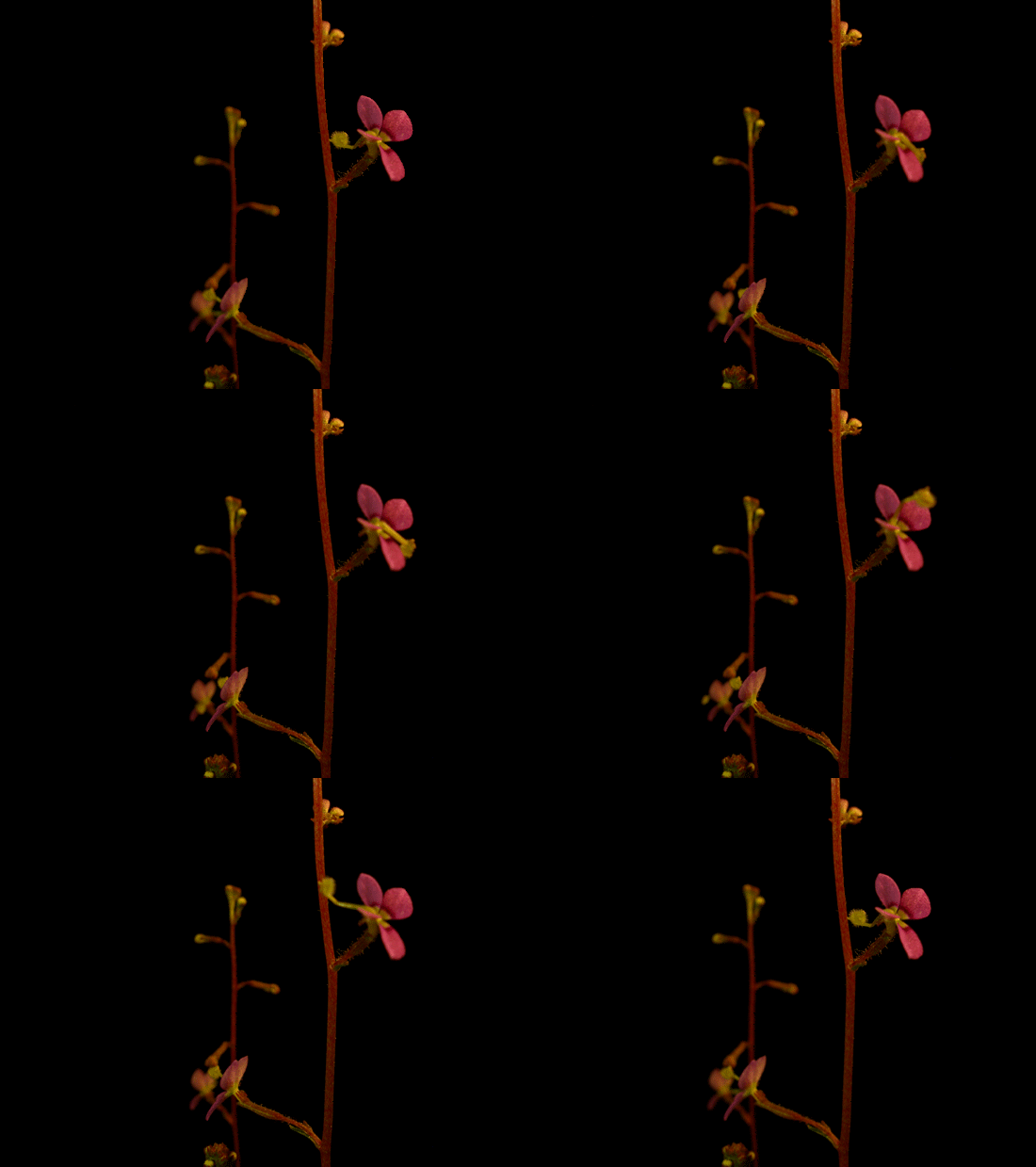
There are plenty of reasons to be interested in Stylidium. For starters, the genus probably has around 300 species, which makes it the fifth largest genus in Australia. Their variety in color and habit (ephemeral, climber, creeper) is astounding. Did I mention that they may be carnivorous? Most notable of all, perhaps, is the irritable column or "trigger" - the fused male and female reproductive organs that hang beneath the flower and snaps into action, dusting pollinators with pollen when they come for a sip of nectar.

Stylidium debile - An animation of the column resetting after firing; each frame is 1 min.

The complex column, a feature that many plant groups possess combined with the fact that it is one of the faster plant movements in completing its swing in 15 milliseconds is amazing enough. But if you really study this variable genus, you will find diagnostic differences in the morphology of that remarkable column. There's one particular group singled out for its interesting characteristics. I'll let Rica Erickson, the distinguished Western Australian naturalist who passed away just a few years ago at the age of 101, describe this for us:
There is a peculiar in-folding at the apex of the Locket Triggerplant's column. It bends forward into a pouch formed by the dilatation of the column itself. It thus resembles a miniature locket with elastic hinges, enclosing the precious packet of pollen inside the lid. This can be prised apart with a pin to reveal the four neat divisions of the anthers within. ... As the stigma develops it becomes more bulky and no doubt heavy enough to cause the hinge to lose some of its elasticity and at this stage the locket hangs partly open. (Triggerplants, 1958. p. 70.) [Emphasis added]
So, the anthers develop first, then thwack, the trigger deposits pollen on the back of visiting grey-flies. After the pollen is shed, the sticky stigma develops and pushes the anthers out of the way. The plant is now ready to receive pollen from other plants in the same manner that it just parted with its own pollen, a clever evolutionary adaptation to promote cross-fertilization.

Stylidium turbinatum - Column in the set position to the left and beneath the
petals, with prominent stigma and anthers pushed to the side. The "locket" here
is somewhat open, possibly because the stigma is heavier or because of multiple firings.
Source: Holger Hennern.

(I should mention here that a modern interpretation of species that possess a cunabulum by Australian botanist Juliet Wege excludes S. turbinatum, noting that the column is only slightly broadened and a complete cradle for the anthers is not formed; Wege, 2006.) With the above photo of Stylidium turbinatum in mind, let's take a closer look at just the column of a different species, as drawn by another Australian botanist, Allen Lowrie:

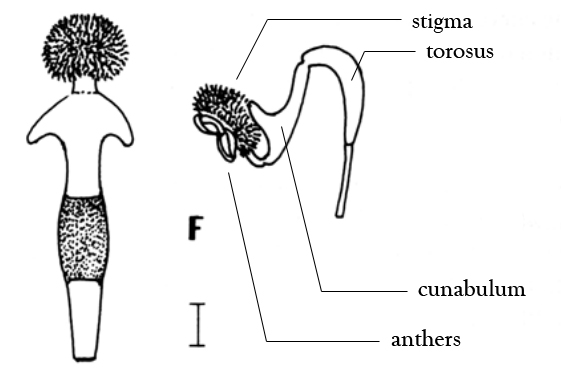
Stylidium perizostera column - (Left) Looking down from
above and (right) view from the side. Scale bar = 1 mm.
Original drawing from Lowrie & Kenneally (1997), annotated by me.

At last! The cunabulum is clearly illustrated. This particular species, Stylidium perizostera, has lateral wings on the cunabulum. Most other cunnabula on other locket triggerplant species consist of a simple pouch. Both of the unfamiliar terms in the drawing above, cunnabulum (Latin: cradle) and torosus (Latin: muscular; in Stylidium, the sensitive mobile hinge) were chosen by Kenneally and Lowrie (1994) to be applied to the locket and hinge, respectively. Since then both words have been used only occasionally in this context, so they still remain obscure botanical terms, but they're useful when trying to use these features as diagnostic differences between species. To emphasize the special adaptation of the cunabulum, compare the backside of the widened portion of the column that corresponds to the cunnabulum in Stylidium turbinatum and the slender, smooth column found in other species like Stylidium purpureum.

So... what does it do?

Lizard Trigger plant
Stylidium preissii - the lizard
triggerplant, also with a cunabulum.
Photo by Jean Hort.
You may be asking yourself, it's a cradle that holds the anthers, so what? Is there any particular function that we can infer from the morphology? Rica Erickson, again:
What is the function of this peculiar modification of the Locket Triggerplant's column? Let us watch. We must stoop very low because the plant grows close to the ground, moreover the trigger is very small. Fortunately the flies are not too wary and we can see them probing. Notice how the column suddenly shoots over. See how the force of the flying trigger flings open the locket. The anthers are held erect and pressed against the fly's shoulder. The insect flies away and swiftly the elastic hinge refolds the anthers again. The trigger has to jerk quickly to swing open the locket.

What then can be the function of the pouch? Does it conserve the moisture of the pollen grains during the dry October heat? Or is it an economical device for saving the loose grains that spill out of the anthers while waiting for insect visitors? That may be the answer, for some pouches retain a little cluster of loose grains near the hinge. (Triggerplants, 1958. p. 70.) [Emphasis added]
After Erickson's initial hypotheses of preventing desiccation or loss prevention of precious pollen, the American botanist Sherwin Carlquist had his own impressions of the locket. One of my personal botanical heros, Carlquist began studying Stylidium species on his trip to Western Australia in 1962 with the aid of Erickson's book which he had found in a Perth bookstore. He returned to Australia several times and identified many new species in his meticulous studies of the Australian flora. In 1969, Carlquist addressed the widened columns or "lockets" mentioned by Erickson. In his assessment, the adaptation "appears to be nothing more or less than a method of achieving self-pollination" (Carlquist, 1969). While Erickson didn't explicitly mention self-pollination, the meaning can be inferred from her suggestion that the cunabulum saves the loose pollen grains, presumably for the stigma to receive.

But as Juliet Wege, the botanist currently working on Stylidium, mentions, many species in this genus have lethal post-zygotic barriers to self-fertilization. That is to say that if pollen from genetically identical individuals is received on the stigma, fertilization occurs but the embryo is aborted and viable seed is not produced. By all accounts, the floral column and trigger mechanism evolved to promote cross-pollination, further supported by the post-zygotic seed abortion found in perennial triggerplants of southern Australia. Wege concludes that, "[i]t is therefore unlikely that the locket has evolved as a self-pollination mechanism in the perennial creeping species..." (Wege, 2006). Wege goes on to explain that tropical annual species, on the other hand, that also have a widened column may have evolved the pouch-like dilation fringed by hairs (papillae) to retain pollen and promote self-fertilization. Annuals, after all, depend on high seed set to survive from year to year.

Stylidium eriopodum
Stylidium eriopodum - Here just to break up the wall of text. Photo by Jean Hort.


So if the function isn't pollen retention for self-fertilization among the perennial triggerplants from southern Australia, what about the other hypotheses? Erickson's idea that it prevents desiccation of pollen during the hottest and driest months of the season has not received much mention or any data to support or refute it. Wege (2006) throws one more hypothesis into the mix by noting her field observations that pollinators, specifically long-tongued flies, will hover near recently triggered flowers to steal pollen from the anther before it has the chance to reset. Could the cunabulum provide protection from pollen pilferers? It's an attractive idea, but no published data exists.

While we're left wondering what the exact function of a dilated column, pouch, locket, or true cunabulum is, we can also ponder the evolutionary history of the trait. We have widened columns of different varieties from simple to elaborate present in multiple lineages of Stylidium: tropical annuals, creeping perennials, tile-leaf triggerplants like S. preissii, scale-leaf triggerplants, and whorled-leaf triggerplants. Wege is currently working on the phylogeny of the genus, but it's quite clear that this "peculiar modification" has arisen a number of times in the evolutionary history of the genus. I look forward to resolutions of such interesting questions as these.

It is amazing to me how much can be written about, and inferred from, the structure of an morphological adaptation no greater than 3 mm long on the reproductive floral column found on a genus of Australian plants. This is why botany is endlessly fascinating. This is why I love botany.


References:
Carlquist, Sherwin (1969). Studies in Stylidiaceae: new taxa, field observations, evolutionary tendencies. Aliso, 7, 13-64.

Erickson, Rica (1958). Triggerplants. Paterson Brokensha Pty. Ltd., Perth.

Kenneally, KF, & Lowrie, A (1994). Stylidium costulatum (Stylidiaceae), a new tropical species of triggerplant from the Kimberley, Western Australia and the lectotypification of S. floodii. Nuytsia, 9 (3), 343-349.

Lowrie, A, & Kenneally, KF (1997). Eight new species of triggerplant (Stylidium: Stylidiaceae) from northern Australia. Nuytsia, 11 (2), 199-217.

Wege, J (2006). Taxonomic notes on the locket trigger plants from Stylidium subgenus Tolypangium section Repentes. Nuytsia, 16 (1), 207-220.


Thanks to Paul of the Texas Triffid Ranch for the recent mention. It provided motivation to finally get around to this overdue post. Cheers!